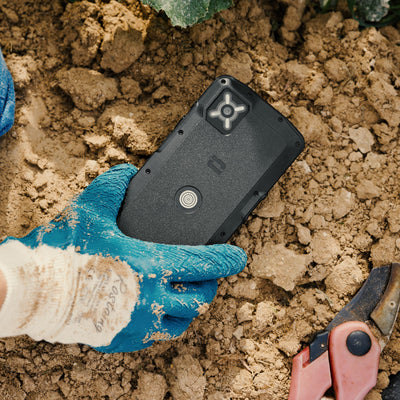
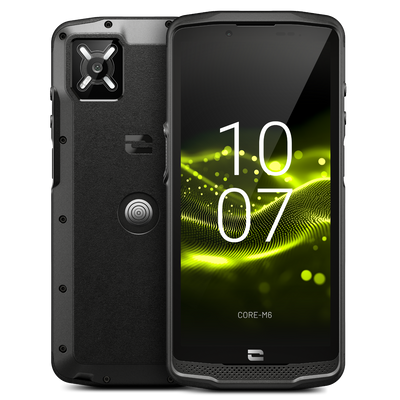
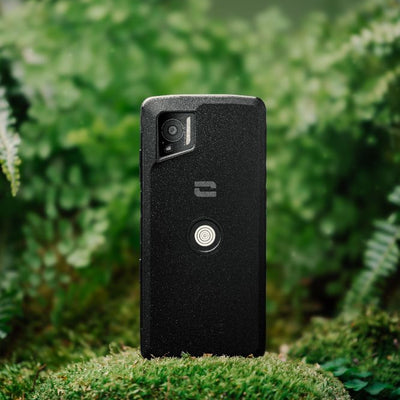
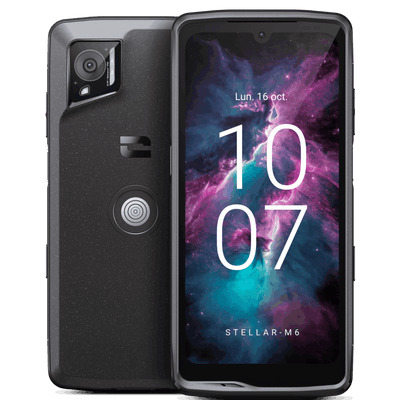

For a tradesperson, choosing a smartphone isn't just about buying another phone. It's about equipping yourself with a work tool that can keep up with a demanding, often unpredictable daily routine—one that's rarely gentle on the device.
Construction workers, electricians, plumbers, heating engineers, carpenters, farmers… every profession has its own challenges. But they all face the same threats to their smartphones: dust, drops, moisture, extreme temperatures, and long days without a power outlet nearby.
A standard smartphone simply isn't built for this. Its limitations become apparent within the first week of use in the field. And every breakdown, every cracked screen, means that part of your business comes to a halt along with it.
In this guide, we’ll help you identify the key factors to consider when choosing a smartphone that’s truly suited to your line of work, and explain why a rugged smartphone, or more commonly known as a durable smartphone, can actually change the way you work.
Why choose a rugged smartphone over a standard smartphone?
From morning to night, between job sites, travel, customer calls, and administrative tasks, your smartphone is always by your side. It takes photos of job sites, guides you from one appointment to the next, and lets you send a quote between jobs. It’s your number one work tool.
Except that a standard smartphone wasn't designed for that.
Designed for indoor use in a controlled environment, it rarely lasts more than a day of heavy use. A drop onto concrete, a splash of water, a bit of plaster in the charging ports… and it breaks down. Sometimes permanently. And often at the worst possible moment.

Battery life is another sticking point. In the reality of a day in the field—with GPS running constantly, an unstable network, and calls coming one after another—the battery of a standard smartphone reaches its limit well before the end of the day.
Finally,the design of a standard smartphone isn't suited for field use: you can't use the screen while wearing gloves, the speaker isn't loud enough in a noisy workshop, and there are no shortcut buttons for essential functions.
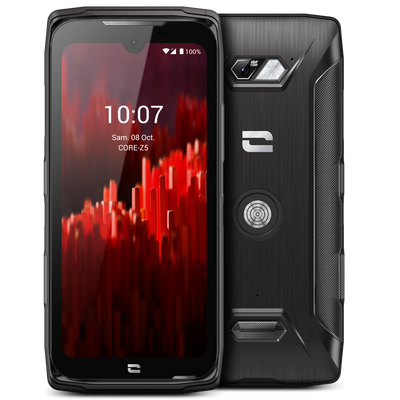
A rugged smartphoneis the exact opposite. It is designed from the ground up to handle all these challenges, without compromising performance or the user experience.
It withstands bumps and dust without batting an eye.
Its long-lasting battery frees you from the hassle of recharging throughout the day
In the field, its touchscreen works even when you're wearing gloves, and its physical buttons give you instant access to key functions.
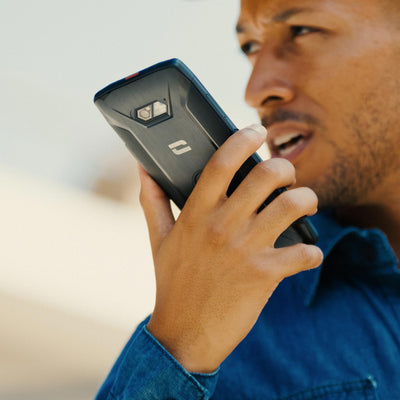
In a noisy environment, its powerful speaker system lets you make and receive calls without having to isolate yourself.
It can even take the place of your computer when finalizing a quote or sending a report.
It can even function as a payment terminal, allowing your customers to pay for your services directly on your phone.
This isn't just a phone you slip a protective case onto. It's a device built to be rugged, designed to last and to go wherever you go.
Key factors to consider when choosing a smartphone for artisans
Battery life that delivers
Battery life is often the first factor people mention. And yet, it’s also the one that gets the lowest ratings.
The figures listed in the technical specifications are measured under ideal conditions, which are far removed from the reality faced by a tradesperson. In the field, a smartphone is constantly in use: GPS is active, calls are frequent, photos of the job site are taken, and the network connection is sometimes unstable—all of which drain the battery faster. Under these conditions, a standard battery runs out quickly.
The goal: a real-world battery life of at least 30 hours, capable of lasting a full day of intensive use without needing tobe recharged.
Cold weather also plays a key role. In winter or in a cold storage room, a standard battery can drain rapidly. A smartphone designed for tradespeople is built to operate reliably down to -20°C, without the battery failing at a critical moment.
Ultimately, good battery life is also measured over the long term. A high-quality smartphone goes through charge cycles day after day, year after year. A battery that lasts 30 hours when you first buy it but only 15 hours after a year is a problem. That’s why smartphones designed for professionals are built to maintain their performance over time—and come with a battery warranty of up to 5 years.
Because a good battery lifeisn’t just a matter of everyday convenience: it’s the guarantee that you’ll never be stranded at the wrong moment, whether today or three years from now.
Durability: Much More Than Just a Thick Shell
The durability of a smartphone for tradespeople isn’t just about a design reinforced by a protective case. It’s based on specific certification standards, starting with the MIL-STD-810H military standard, which subjects the device to tests under extreme conditions:
Repeated falls on hard surfaces
Prolonged vibrations
Moisture and splashes
Significant temperature fluctuations
The goal isn't to withstand an exceptional accident. It's to withstand intensive daily use, day after day, without any loss of performance.

In practical terms: your smartphone might drop onto concrete several times a day, take a few knocks, or be exposed to vibrations from construction equipment—and still keep working normally.
This durability is changing the way people think about purchasing. People no longer replace their phones every year just because they break. Instead, they invest in a device that supports their needs over the long term.
Completely waterproof: water, mud, dust
Water and dust are among the leading causes of malfunctions in standard smartphones. On construction sites or during outdoor work, they are everywhere.
A craftsman's smartphone must be certified IP68 and IP69K :
IP68 : resistance to prolonged immersion
IP69K : resistant to high-pressure, high-temperature water jets — ideal for cleaning after a day in the mud or construction dust
Dust protection is just as critical. Plaster, sawdust, cement—these fine particles get everywhere. The IP6X guarantees total protection against these intrusions, which can irreparably damage the internal components of a standard smartphone.
The result: you use your smartphone without a second thought. No matter the weather, no matter the job site.

Ergonomics: designed to be used even when your hands are full
On a construction site, your hands are rarely clean and free. You wear gloves, handle tools, and your fingers are wet or covered in dust. In this context, ergonomics isn’t just a minor detail—it’s essential for safe use.
A good smartphone for a tradesperson should offer:
A screen readable in direct sunlight, responsive to touch even when wearing gloves or with wet hands
Some programmable physical buttons for instant access to frequently used functions—without navigating through menus
An intuitive interface, designed for quick use in the field

The goal: a completely seamless user experience. Every second saved adds up over the course of the day.
Embedded artificial intelligence: an invisible but effective assistant
Newer smartphones come equipped with AI assistants capable of simplifying many everyday tasks. For a tradesperson, this translates into tangible time savings:
Dictate a message without stopping
Schedule an appointment using voice commands
Start a route or perform a quick calculation without touching the screen
These features let you stay focused on your work while managing your schedule in real time. It’s a small benefit, but one that adds up throughout the day.
Connectivity: Staying reachable even in areas with poor reception
Tradespeople often work in environments with unreliable cell service: steel-framed buildings, basements, remote job sites, and rural areas. A standard smartphone easily loses signal in these conditions.
A rugged smartphone is designed with enhanced network reception. With 5G compatibility, it maintains a stable connection where others lose signal.
The result: you stay connected, transfer your files quickly, and keep working without interruption.
Communication and security: features that can make all the difference
On a construction site, communication must be clear, fast, and reliable. Background noise is a constant presence. Powerful speakers and noise-canceling technology during calls are therefore essential for both being heard and hearing clearly.
Some smartphones designed for tradespeople include a dedicated Push-to-Talk (PTT) button , allowing you to communicate instantly with the entire team, just like a walkie-talkie—but more reliably and without any additional equipment.
Personal safety is another major concern, particularly for tradespeople who work alone or in hazardous environments. A smartphone designed for these purposes includes reliable and appropriate Lone Worker Protection (LWP) that are reliable and tailored to their needs:

Fall and Inactivity Detection : in the event of a loss of balance or a sudden fall
Real-time location sharing : so you can be located instantly by your team or emergency services
Dedicated SOS button : accessible even when wearing gloves or with dirty hands
Automatic emergency call : triggered in the event of an emergency
Smartphones are no longer just communication tools; they have become true safety devices that keep an eye on tradespeople throughout their day.
Which smartphone should you choose based on your profession?
Construction: Prioritizing Durability and Reliability
On construction sites, conditions are among the harshest imaginable. Falls onto concrete, abrasive dust, vibrations from machinery, and splashes of water or debris—the environment shows no mercy to fragile equipment.
The top priorities for professionals in the construction :
Maximum shock resistance, MIL-STD-810H certified, to withstand repeated drops without interrupting operation
IP68 + IP69K waterproofing, to withstand rain and high-pressure cleaning after a day on the job site
Complete protection against dust (IP6X), against cement, plaster, and abrasive particles
Powerful audio and Push-to-Talk, for effective communication in noisy environments
SOS and PTI Button, for safe working, even when working alone
Plumbers, electricians, heating engineers: prioritizing versatility and productivity
For these tradespeople, the smartphone is central to every job. They use it to communicate with clients, document their work, send quotes, and manage schedules. Their needs are therefore more diverse.
Key criteria:
Sufficient battery life to cover a full day of operations without recharging
Reliable connectivity in all environments, including basements or buildings under construction
High-performance camera to document jobs and prepare estimates
Optimal ergonomics : screen can be used with wet or dirty hands, quick access to essential apps
A particularly useful feature for these profiles: the X-SPACE from Crosscall, which turns a smartphone into a full-fledged desktop workstation simply by connecting it to a monitor. After a job at a client’s site, the tradesperson can immediately send a report, finalize a quote, or update a file—without returning to the office or switching devices.
One tool, from the field to the office.
Farmers and landscapers: prioritizing self-sufficiency and resilience
In the agricultural sector, smartphones are used outdoors for long hours in often unpredictable conditions. Rain, mud, dust, fluctuating temperatures, and limited access to power sources: the challenges are numerous.
Key criteria:
Multi-day battery life so you don't have to rely on daily recharging
Waterproof and resistant to mud and dust for use without special precautions
Accurate GPS to optimize travel on large farms
Compatibility with gloves — a criterion that is often overlooked but essential in these professions

Standard Smartphone vs. Smartphone for Tradespeople: The Complete Comparison
dx kj
Criterion |
|
Smartphone for tradespeople |
Impact resistance |
Limited; breaks frequently at 1 m |
MIL-STD-810H, repeated drops from up to 2 meters onto concrete |
Waterproofing |
IP68 at best, brief immersion |
IP68 + IP69K, immersion + high pressure |
Temperatures |
-10°F to +40°F | -20°F to 60°F |
Autonomy |
Rarely more than 30 hours of actual use | Up to 80 hours of battery life |
Dust |
Partial or no protection | Full IP6X protection |
Network connectivity |
5G standard | 5G with enhanced network coverage in enclosed and isolated environments |
GPS |
Standard accuracy (~10–15 m) | Improved accuracy (5 m), off-road navigation |
Field ergonomics |
1 to 2 basic buttons | 3 programmable buttons: PTT (Push-To-Talk), SOS, and IA (compatible with gloves and wet hands) |
Warranty |
2 years (battery not included) | 5 years, battery included |
Our selection of Crosscall smartphones for tradespeople
FAQ: Smartphones for Tradespeople
What is the best rugged smartphone for a tradesperson?
The best smartphone for tradespeople combines MIL-STD-810H certification, IP69K water resistance, and a real-world battery life of over 48 hours. The Crosscall CORE-M6 meets all of these criteria and is currently the gold standard for manual trades and intensive field use.
Which smartphone should you choose for working on a construction site?
If you regularly work alone, look for a model with programmable physical buttons, a screen that can be used while wearing gloves, and PTI safety features. MIL-STD-810H-certified shock resistance and IP68/IP69K water resistance are essential requirements for daily use on construction sites.
What is the most durable and waterproof phone on the market?
Smartphones certified to MIL-STD-810H and IP69K standards offer the highest level of protection available. They can withstand high-pressure water jets, can be cleaned after a day in the mud or construction site dust, and can survive repeated drops from a height of 2 meters onto a hard surface without damage.
How much battery life does a smartphone for artisans need?
A tradesperson needs a smartphone that can last at least two days in real-world use, with GPS enabled and the network active. This ensures complete freedom of movement in the field, without having to rely on recharging during the day.
Is a rugged smartphone really more cost-effective than a standard smartphone?
Yes, and over the long term, the difference is significant. Thanks to its resistance to shocks, water, and dust, a rugged smartphone drastically reduces the risk of breakage and the need for replacement. Its robust design, 5-year warranty (battery included), and field-ready features make it a sustainable investment that generates real savings on repair and equipment replacement costs.