
Choosing a smartphone as a craftsman is not just buying another phone. It’s equipping yourself with a work tool capable of keeping up with a demanding daily routine, often unpredictable, and rarely gentle on equipment.
Builder, electrician, plumber, heating engineer, carpenter, farmer… every profession has its own constraints. But all share the same smartphone enemies: dust, shocks, humidity, extreme temperatures, and long days without a power outlet nearby.
A standard smartphone is simply not made for this. It shows its limits from the first week in the field. And every breakdown, every cracked screen, is a part of your business that stops with it.
In this guide, we help you identify the essential criteria to choose a smartphone truly suited to your profession, and understand why a rugged smartphone, or more commonly called a rugged smartphone, concretely changes the way you work.
Why choose a rugged smartphone rather than a standard smartphone?
From morning to night, between job sites, travel, client calls, and administrative tasks, your smartphone never leaves your side. It takes site photos, guides you from one appointment to the next, lets you send a quote between jobs. It’s your number one work tool.
Except a standard smartphone wasn’t designed for that.
Designed for indoor use, in a controlled environment, it rarely lasts more than a full intensive day. A fall on concrete, a splash of water, some plaster in the charging ports… and it’s a breakdown. Sometimes permanent. And often at the worst moment.

Battery life is another pain point. In the reality of a day in the field — GPS active all the time, unstable network, back-to-back calls — a consumer smartphone’s battery reaches its limits well before the end of the day.
Finally, the ergonomics of a standard smartphone are not designed for the field: impossible to use the screen with gloves, insufficient speaker in a noisy workshop, no quick access button for essential functions.
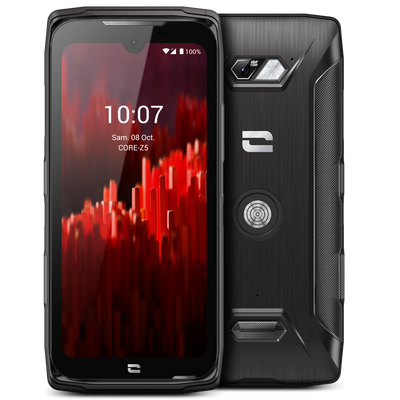
A rugged smartphone, it is the exact opposite. It is designed from the start for all these constraints, without compromising performance or user experience.
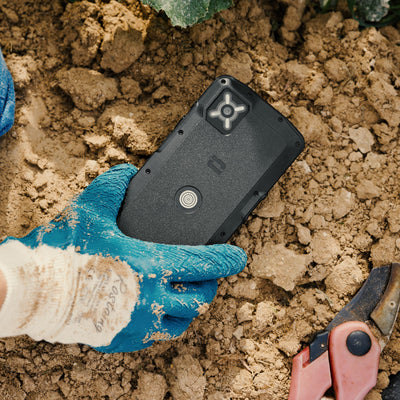
It withstands shocks and dust without flinching.
Its long-lasting battery frees you from charging constraints during your day
In the field, its touchscreen works with gloves, and its physical buttons give you immediate access to key functions.
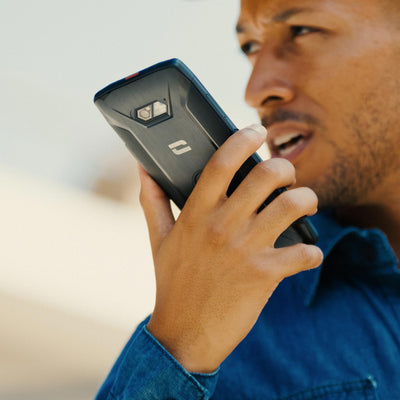
In a noisy environment, its powerful sound system lets you make and receive calls without needing to isolate yourself.
It can even replace your computer to finalize a quote or send a report.
It can even serve as a payment terminal (POS) so your clients can pay for your services directly on your phone.
It's not a phone to which you add a protective case. It's a tool that integrates its own toughness, designed to last and follow you everywhere.
Essential criteria for choosing your craftsman's smartphone
Battery life that meets expectations
Battery life is often the first criterion mentioned. Yet, it is also the most poorly assessed.
The figures announced on technical sheets are measured under ideal conditions, far from the reality of a craftsman. In the field, the smartphone is constantly in use: GPS active, frequent calls, site photos, sometimes unstable network — all of which consume more power. Under these conditions, a standard battery drains quickly.
What to aim for: a real battery life of at least 30 hours, capable of lasting a full day of intensive work without needing a recharge.
Cold also plays a crucial role. In winter weather or in a cold room, a standard battery can drop sharply. A smartphone designed for craftsmen is built to operate reliably down to -20°C, without the battery failing at a critical moment.
Finally, good battery life is also evaluated over the long term. A craftsman's smartphone goes through charge cycles day after day, for years. A battery that lasts 30 hours when new but only 15 after one year is a problem. That's why smartphones designed for professionals are made to maintain their performance over time — and come with a battery warranty of up to 5 years.
Because a good battery life, it's not just a matter of daily comfort: it's the guarantee of never being stuck at the wrong moment, today or three years from now.
Durability: much more than a thick case
Durability durability a craftsman's smartphone is not just about a reinforced design with a protective case. It is based on precise certification standards, starting with MIL-STD-810H military standard, which subjects the device to extreme condition tests:
Repeated drops on hard surfaces
Prolonged vibrations
Humidity and splashes
Significant temperature variations
The goal is not to withstand a rare accident. It is to endure intensive daily use, day after day, without performance degradation.

Practically: your smartphone can fall several times a day on concrete, take hits, be exposed to vibrations from construction machinery — and keep working normally.
This durability changes the buying logic. You no longer replace your phone every year after a break. You invest in a tool that supports your work long-term.
Total waterproofing: water, mud, dust
Water and dust are among the leading causes of failure in standard smartphones. On a worksite or during outdoor interventions, they are everywhere.
A craftsman’s smartphone must be certified IP68 and IP69K :
IP68 : resistance to prolonged immersion
IP69K : resistance to high-pressure, high-temperature water jets — ideal for cleaning after a day in mud or construction dust
Dust protection is just as critical. Plaster, sawdust, cement — these fine particles get everywhere. The certification IP6X guarantees total protection against these intrusions, which can irreparably damage the internal components of a standard smartphone.
Result: you use your smartphone without any hesitation. Whatever the weather, whatever the site.

Ergonomics: designed to be used even with busy hands
On a worksite, hands are rarely clean and free. You wear gloves, handle tools, and have wet or dusty fingers. In this context, ergonomics is not a detail: it is a condition of use.
A good smartphone for craftsmen must offer:
A screen readable in bright sunlight, responsive to touch with gloves or wet hands
Some programmable physical buttons to instantly access the most used functions — without going through menus
One intuitive interface, designed for quick use in the field

The goal: zero friction in use. Every second saved adds up throughout the day.
Built-in artificial intelligence: an invisible but effective assistant
Recent smartphones include AI assistants capable of simplifying many everyday tasks. For a craftsman, this translates into very tangible time savings:
Dictate a message without stopping
Schedule an appointment by voice
Start a route or perform a quick calculation without touching the screen
These features allow you to stay focused on work while managing your schedule in real time. A subtle gain that adds up throughout the day.
Connectivity: stay reachable even in difficult areas
Craftsmen often work in environments where the network is unreliable: metal buildings, basements, isolated sites, rural areas. A standard smartphone easily loses connection in these conditions.
A rugged smartphone is designed with a enhanced network gripCompatible with 5G, it maintains a stable connection where others lose signal.
Result: you stay reachable, transfer your files quickly, and keep working without interruption.
Communication and safety: features that can make a difference
On a construction site, communication must be clear, fast, and reliable. Ambient noise is a constant reality. Powerful speakers and noise reduction technologies during calls become essential to be heard and to hear properly.
Some smartphones for craftsmen include a Push-to-Talk (PTT) button a dedicated feature that allows instant communication with the entire team, like a walkie-talkie — more reliable and without extra equipment.
Individual safety is another major concern, especially for craftsmen working alone or in hazardous environments. A smartphone designed for these uses includes PTI (Lone Worker Protection) features reliable and suitable:

Fall and immobility detection : in case of loss of verticality or sudden fall
Real-time location sharing : to be instantly located by the team or emergency services
Dedicated SOS button : accessible even with gloves or dirty hands
Automatic emergency call : triggered in critical situations
The smartphone is no longer just a communication tool: it becomes a true safety device, watching over the craftsman throughout the day.
Which smartphone to choose based on your profession?
Construction: focus on durability and reliability
On construction sites, conditions are among the harshest there are. Falls on concrete, abrasive dust, equipment vibrations, splashes of water or materials, the environment shows no mercy to fragile equipment.
The top priorities for professionals in Construction and public works :
Maximum shock resistance, MIL-STD-810H certified, to withstand repeated drops without interrupting activity
IP68 + IP69K waterproofing, to withstand rain as well as high-pressure cleaning after a day on site
Total dust protection (IP6X), against cement, plaster, and abrasive particles
Powerful audio and Push-to-Talk, to communicate effectively in noisy environments
SOS and lone worker button, to work safely, even alone
Plumbers, electricians, heating technicians: priority on versatility and productivity
For these craftsmen, the smartphone is at the heart of every job. It is used to communicate with clients, document work, send quotes, manage schedules. The needs are therefore more versatile.
Key criteria:
Sufficient battery life to cover a full day of work without recharging
Reliable connectivityin all environments, including basements or construction sites
High-performance camera to document interventions and prepare quotes
Optimal ergonomics : screen usable with wet or dirty hands, quick access to essential apps
A particularly useful feature for these profiles: the solution X-SPACE from Crosscall, which allows you to turn your smartphone into a true fixed workstation, simply by connecting it to a screen. After a visit to a client, the craftsman can directly send their report, finalize a quote, or update a file — without returning to the office, without changing equipment.
A single tool, from the field to the office.
Farmers and landscapers: priority on battery life and durability
In the agricultural world, the smartphone is used outdoors, over long days, in often unpredictable conditions. Rain, mud, dust, varying temperatures, distance from power sources: the constraints are many.
Priority criteria:
Multi-day battery life to avoid relying on daily charging
Waterproof and resistant to mud and dust for use without special precautions
Accurate GPS to optimize movement across large farms
Glove compatibility — a criterion often overlooked but essential in these trades

Classic smartphone vs smartphone for craftsmen: the complete comparison
dx kj
Criterion |
Smartphone |
Smartphone for craftsmen |
Drop resistance |
Limited, frequent breakage from 1m |
MIL-STD-810H, repeated drops up to 2m on concrete |
Water resistance |
IP68 at best, short immersion |
IP68 + IP69K, immersion + high pressure |
Temperatures |
-10° to +40°C | -20° to +60°C |
Battery life |
Rarely more than 30h in real use | Up to 80h, long-lasting battery |
Dust |
Partial or no protection | Total IP6X protection |
Network connectivity |
Standard 5G | 5G with enhanced network reception in closed and isolated environments |
GPS |
Standard accuracy (~10-15m) | Improved accuracy (5m), field navigation |
Field ergonomics |
1 to 2 basic buttons | 3 programmable buttons: PTT (Push-To-Talk), SOS, and AI (compatible with gloves and wet hands) |
Warranty |
2 years (battery often excluded) | 5 years, battery included |
Our selection of Crosscall smartphones for craftsmen
FAQ: smartphones for craftsmen
What is the best all-terrain smartphone for a craftsman?
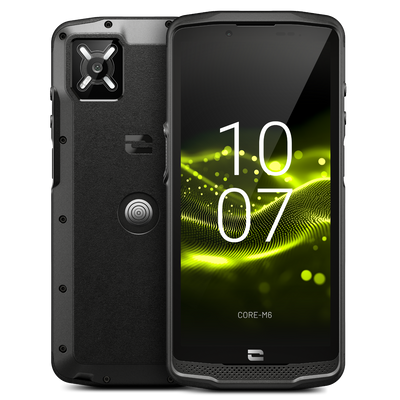
The best smartphone for craftsmen combines MIL-STD-810H certification, IP69K waterproofing, and real battery life of over 48 hours. The Crosscall CORE-M6 meets all these criteria and currently stands as the reference for manual trades and intensive field use.
Which smartphone should you choose for working on a construction site?
Choose a model with programmable physical buttons, a screen usable with gloves, and PTI safety features if you often work alone. MIL-STD-810H shock resistance certification and IP68/IP69K waterproofing are non-negotiable criteria for daily construction site use.
What is the most durable and waterproof phone on the market?
Smartphones certified MIL-STD-810H and waterproof to IP69K represent the highest level of protection available. They withstand high-pressure water jets, can be cleaned after a day in mud or construction dust, and endure repeated drops from 2 meters onto hard surfaces without damage.
What battery life is needed for a craftsman's smartphone?
A craftsman needs a smartphone capable of lasting at least two days in real use, with GPS active and network in use. This ensures complete freedom of action on site, without relying on recharging during the day.
Is a rugged smartphone really more cost-effective than a regular smartphone?
Yes, and in the long term, the difference is significant. Thanks to its resistance to shocks, water, and dust, a rugged smartphone drastically reduces the risk of breakage and the need for replacement. Its robust design, 5-year warranty including the battery, and features adapted to the field make it a durable investment that generates real savings on repair and equipment renewal costs.