
What is the best battery life for a rugged smartphone?
You've probably experienced the battery dying during an outing and had to turn off GPS or the screen to save what remains. Situations like this can quickly ruin a workday or an outdoor trip. With a phone truly designed for your activity, this shouldn't be a problem.
In general, the battery life displayed by regular smartphones is hard to interpret without really knowing the testing protocols. As a result, the displayed battery life rarely corresponds to real usage...
That's the whole difference between advertised battery life and real battery life. The mAh figure indicated on the product sheet remains a technical specification that doesn't say much about the battery's behavior in real-world use. A new European energy label now requires brands to communicate battery life measured under real conditions, not just standby.
This battery life corresponds to the duration of smartphone use with a full charge, expressed in hours and minutes per battery cycle. It is obtained through a European protocol common to all manufacturers: the phone undergoes 2.5-hour test cycles simulating various daily uses (4G calls, web browsing, video playback, and standby phases) until it completely shuts down. The result thus indicates how long the smartphone can operate on a single charge according to a standardized usage scenario, offering a more reliable comparison between models.
For a professional, on a construction site, on tour, in the field, or for someone practicing outdoor activities, battery life is not a minor detail.
This is what allows you to get through an entire day without relying on a power outlet or an additional charge during the day. A smartphone designed to last must be able to keep up, even when the day gets longer.
What is good battery life for a rugged smartphone?
Today, most smartphones have around 6,000 mAh capacity, and some exceed 7,000 mAh. But for a rugged smartphone, this number is not the most important. What matters is the real battery life: that is corresponds to the usage conditions defined by the product's energy label.
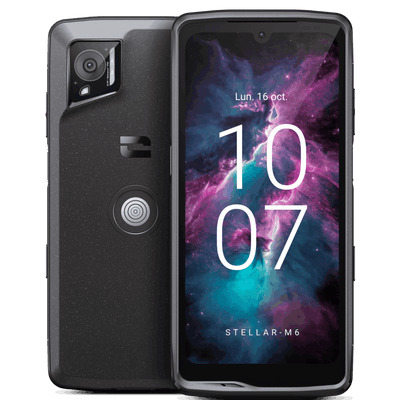
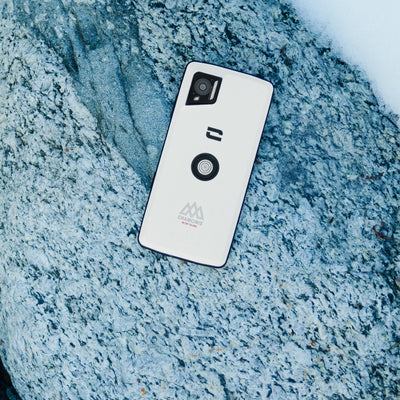
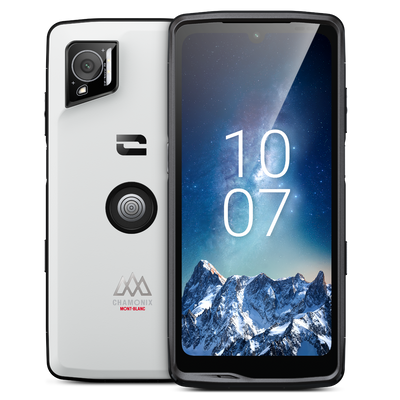
On this point, aiming for at least 48 hours of real battery life is a good benchmark for regular field use. The STELLAR-X5s Chamonix-Mont-Blanc Edition, for example, lasts up to 54 hours in real conditions, a sufficient margin to cover an extended day or outing.
Needs then vary depending on usage:
for basic office use (calls, emails, light browsing), the battery easily lasts;
as soon as GPS, photos, and business apps are added, consumption increases significantly;
in intensive outdoor use (tracking, maps, location sharing), a standard battery can drain in a few hours.
Why do two phones with the same battery capacity not have the same battery life?
Three main factors explain the difference: the processor (some consume less at equal performance), the screen (a 120 Hz panel consumes more than a 60 Hz panel), and software optimization, which determines how the system manages background apps. At equal capacity, a smartphone with long battery life A well-optimized device will therefore last significantly longer than a standard model.
Which uses consume the most battery?
GPS, photo, video, and business applications :
GPS is one of the most power-hungry functions. It’s not the signal reception that drains power, but the continuous position calculation, map updates, and constant communication with satellites. Yet it’s hard to do without: it’s often a safety reference, whether for a delivery person, a security guard on patrol, or a hiker.
The camera and video also consume a lot, especially outdoors: difficult lighting conditions put more strain on the processor and screen, and advanced video modes require heavier image processing. Added to this are business applications: reports, barcode scanning, geotagged photos, walkie-talkie apps, which often run in the background all day.

Mobile network, 5G, and tethering
A smartphone in a low coverage area is never truly at rest: it regularly sends signals to try to connect to a tower. This repeated cycle consumes a lot of power, especially in isolated areas, basements, or poorly covered industrial zones. 5G, being faster, also drains the battery more than 4G when kept continuously active, as does tethering, which is often used in the field to connect a tablet or laptop.
Why does battery life decrease outdoors?
The impact of cold and weather conditions
Temperature has a direct impact on the battery. A battery works optimally between 15 and 35°C. Below -5°C, the battery seems to drain much faster. The phone may even shut down while still showing 20% charge. This phenomenon is reversible once back to room temperature, but on a construction site in winter or in the mountains, this is not always possible.
Conversely, staying above 40-45°C for long periods permanently degrades the battery. That is why a rugged phone must be able to operate over a much wider temperature range than a standard smartphone, ideally from -20°C to +60°C.
Field and mobility constraints
In an office environment, a smartphone usually stays near a power outlet and is not heavily used. Outdoors, the situation is different: full days away from any recharge, constant movement, GPS, network, and screen on simultaneously, sometimes rain or dust as well. This combination of constraints explains why a smartphone discharges much faster in the field than in the office, even with the same battery capacity.
What battery life to expect based on your activity?
Battery life needs vary depending on the profession or activity. Some concrete benchmarks:
- Building site : the construction professionals often work outdoors, with site tracking apps and geotagged photos, without always having access to a power outlet. It is advised to aim for one and a half to two days of battery life.
Logistics : the field teams perform parcel scanning, GPS, and communication throughout the day. Battery life must cover a full day without recharging margin.
Security : the security agents often work irregular hours or night shifts, with walkie-talkie and geolocation active continuously. A battery life of 24 to 48 hours in communication is recommended.
Hiking and outdoor : for outdoor activities, between GPS, tracking, and no recharging for several days, aiming for 48 hours or more is essential for safety.

Activity |
Main uses |
Recommended real battery life |
| Construction / building site |
Photos, business apps, outdoor
|
36 to 48h
|
| Logistics / transport | GPS, scanning, continuous communication |
24 to 36h
|
| Security | Walkie-talkie, geolocation, irregular hours |
24 to 48h
|
| Hiking / outdoor | Intensive GPS, tracking, no recharging |
48h and more
|
How to choose a rugged smartphone with long battery life?
Some criteria to consider:
Battery capacity (mAh) : the higher it is, the greater the potential battery life, although it alone is not enough to judge the real endurance of a device.
Software optimization : a good professional smartphone combine a large-capacity battery with low-power components and efficient background app management.
Power-saving modes : beyond the classic power-saving mode, which restricts all functions, some smartphones allow more precise settings. Crosscall’s Outdoor Mode, for example, can increase battery life by up to 25% without sacrificing essential functions.
Real battery life rather than just battery capacity number : this is the most reliable criterion. A model that lasts 48 hours or more in real use is preferable to a high mAh number that is not representative of field conditions.
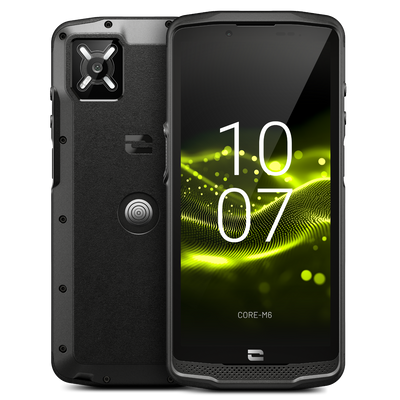
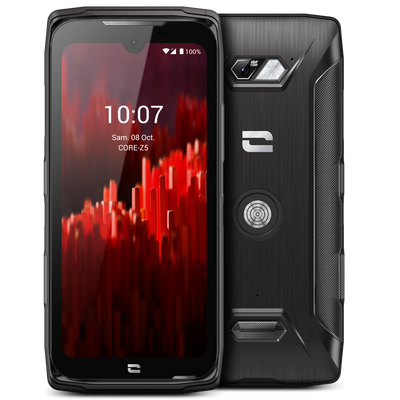
On these criteria, models like the STELLAR-X5s or its version STELLAR-X5s Chamonix Mont-Blanc combine high-capacity battery, Outdoor Mode, and IP68 waterproofing to last up to 54h in real conditions. For more versatile professional use, the CORE-M6 offers a real battery life of 80h, IP68/IP69K waterproofing, and programmable buttons suited to the field.
What level of battery life is expected for a rugged smartphone?
For sustained professional or outdoor use, you should aim for at least 24 to 48 hours of real battery life, with GPS active and network in use. The most durable models, like the STELLAR-X5s Chamonix-Mont-Blanc, reach up to 54 hours in real conditions.
Does cold reduce battery life?
Yes, significantly. Below -5°C, chemical reactions in the battery slow down, which accelerates discharge and can cause the phone to shut down abruptly even though there is still charge displayed. That’s why rugged smartphones are designed to operate over a much wider temperature range than a standard model.
Does GPS consume a lot of battery?
Yes, it is one of the most power-hungry functions. Continuous position calculation, map updates, and constant communication with satellites heavily impact battery life, especially when the network is weak at the same time.
What battery life is expected for a construction site smartphone?
On a construction site, between business applications, geolocated photos, and extended outdoor use, it is recommended to aim for 36 to 48 hours of real battery life to cover a full workday with a safety margin, without relying on easy access to a power outlet.