
Launched in 2021, the NEO 2 program marks a historic turning point in the modernization of French security forces.
On the occasion of Milipol 2025, Marine Pagnon, Head of institutional relations and partnerships at Crosscall, reviews the outcome of 4 years of strategic collaboration with law enforcement and reveals to us its vision for tomorrow's critical communications.
NEO 2 represents a major technological ambition in the Security sector public. How was this project born and how Crosscall has it been able to meet these challenges?
Marine Pagnon: The NEO 2 program is part of a very specific French philosophy of public security. Nour model is based on the presence of officers in plain clothes or uniform directly in contact with the population, ensure local security, deter and provide assistance.
But this field presence requires being increasingly effective and versatile in security, control, andintervention ofergency. The Agence du Numérique des Forces de Security Intérieure (ANFSI) therefore aimed with NEO 2 to equip all officers with a unique smartphone, allowing them to strengthen their mobility and successfully carry out a greater part of their missions directly in the field.
Let's take a concrete example: previously, during an identity check, if the officer needed to verify information about an individual, they had to take them to the station, perform the verification, etc.. In terms of operational efficiency, a lot of time was lost. With NEO 2, the officer accesses police files directly from their smartphone, can perform checks on the move, and make appropriate decisions immediately.
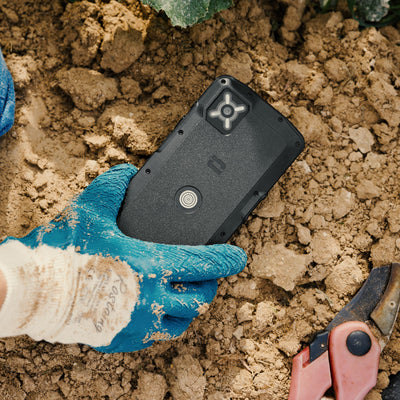
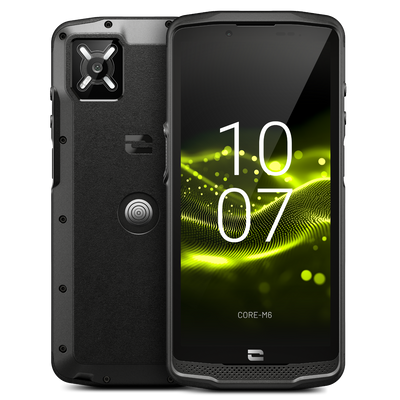
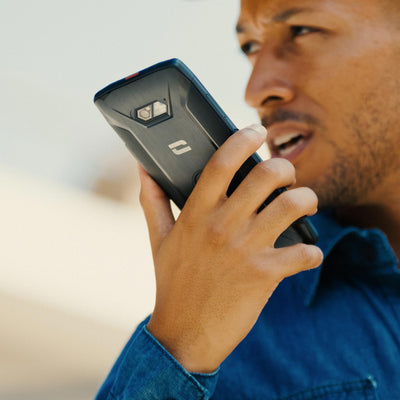
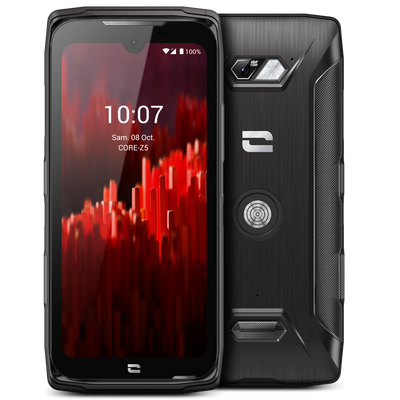
Crosscall has addressed these challenges by relying on what defines our DNA: a smartphone obviously resistant to the most extreme conditions and equipped with extended battery life. But we went further. NEO 2 has become a tool that perfectly integrates into all field uses: from public security missions to road checks with motorcyclists, controls at the borders to the most delicate missions carried out by elite units. It is this versatility that makes all the difference.
What concrete evidence of operational effectiveness have you observed in the field?
M.P.: The most striking figure in my opinion is a breakage rate below 1% across the entire fleet. Considering the number of daily interventions, the harshness of the missions, and the intense mobilization of forces every day for securing major events sports such as the Rugby and Football World Cups, or the Olympic Games, it is a true feat.
Another indicator of success: the initial contract is extended until 2029, well beyond the initially planned duration. This guarantees a much longer usage duration than originally expected, demonstrating the reliability of our equipment over time.
But what may be even more revealing is the increasingly versatile use of smartphones thanks to our entire accessory ecosystem. The X-COMM, for example, was specifically developed to replace the traditional lapel microphone. In noisy environments, it greatly facilitates radio communications while offering ergonomics that agents are accustomed to. The X-COMMAND allows motorcyclists to control their communications directly from the handlebar, without compromising their safety during road checks, and offers the necessary discretion to agents during operationss of surveillance.
How do you explain this success?
M.P. : I would say it rests on two fundamental pillars.
The first is that the product has become much more than a smartphone. It is a true development platform that allows meeting concrete needs and uses evolving. There was real research and development work carried out in collaboration with the Police and the Ggendarmerie Nrational to achieve a product modular that meets to the maximum their operational needs.
The second pillar is our approach to close collaboration. Crosscall is a human-scale structure, which gives us flexibility and agility that larger organizations do not necessarily have giants of the sector. We have dedicated teams that provide support to ANFSI for all development aspects on- custom. This proximity allows us to react quickly, to co-build solutions and to ensure perfect operability with internal security challenges, particularly regarding the protection of sensitive data.
Speaking of proximity, this collaboration was also an opportunity to deploy cutting-edge innovations, especially during the Paris 2024 Olympic Games.
M.P. : Absolutely. The Othem OParis Olympics represented an exceptional public security setup, with forces deployed in very high mobility across all Olympic sites and throughout the Paris region.
This event was an opportunity for a full-scale test of the STORM critical communication network on pSeveral thousand terminals. STORM is the program aimed at replacing conventional radios with 4G communications on smartphones.
As part of the preparation for this major event, we have observed that were missing audio accessories designed to facilitate radio use. In noisy environments, having a dedicated accessory makes perfect sense to streamline communications. This is how the X-COM was bornM, which we have developed entirely custom. It is a rather unique product on the market: both Bluetooth and wired, rugged, ergonomic to meet the operational requirements of the forces field.
What is these large-scale tests foretellsnt for the future of security forces communications?
M.P. This opens the way to even greater modularity. Developments like N are already emergingEO DK with biometric control, which is fully compatible with terminals Crosscall. This will add another layer of functionality in the field.
But the latest major innovation developed by Crosscall, this is the new version of X-SPACE. This solution allows the smartphone to be transformed into a true desktop computer, now with broadcasting on two 4K screens. The agent simply plugs in their smartphone at thescreen, and it has a complete workstation. A single terminal for field missions and office work.
The implications are considerable: substantial savings on the IT fleet, greatly simplified fleet management, and an impact lower environmental impact since the number of necessary devices is drastically reduced. It is estimated that one smartphone can replace up to 5 different terminals.
Moreover, there is the issue of interoperability. With the large-scale deployment of STORM across the entire smartphone fleet of security forces, we are moving towards a convergence of communication tools emergency, with a gradual disappearance of radio in favor of the smartphone.
Finally, the advent of artificial intelligence suggests1st a new development still new to improve team efficiency and collaboration, even though everything is still to be imagined on this point.
How Crosscall is preparing to support this evolution?
M.P. : It must be understood that the NEO 2 program is planned until 2029. This means we will be involved in this program for nearly 10 years. In 10 years, we will have the opportunity to support the deep transformation of the police and gendarmerie profession.
And I think our strength is precisely this ability to remain agile while being reliable in the long term. We are not just a hardware supplier: we are a partner who co-built with our clients ofsolutions forthe future and sustainable. This philosophy takes on its full meaning in a program as strategic as NEO 2. And we are all the more proud of us to be able to do it to alongside women and men who ensure our security every day.